
← All courses

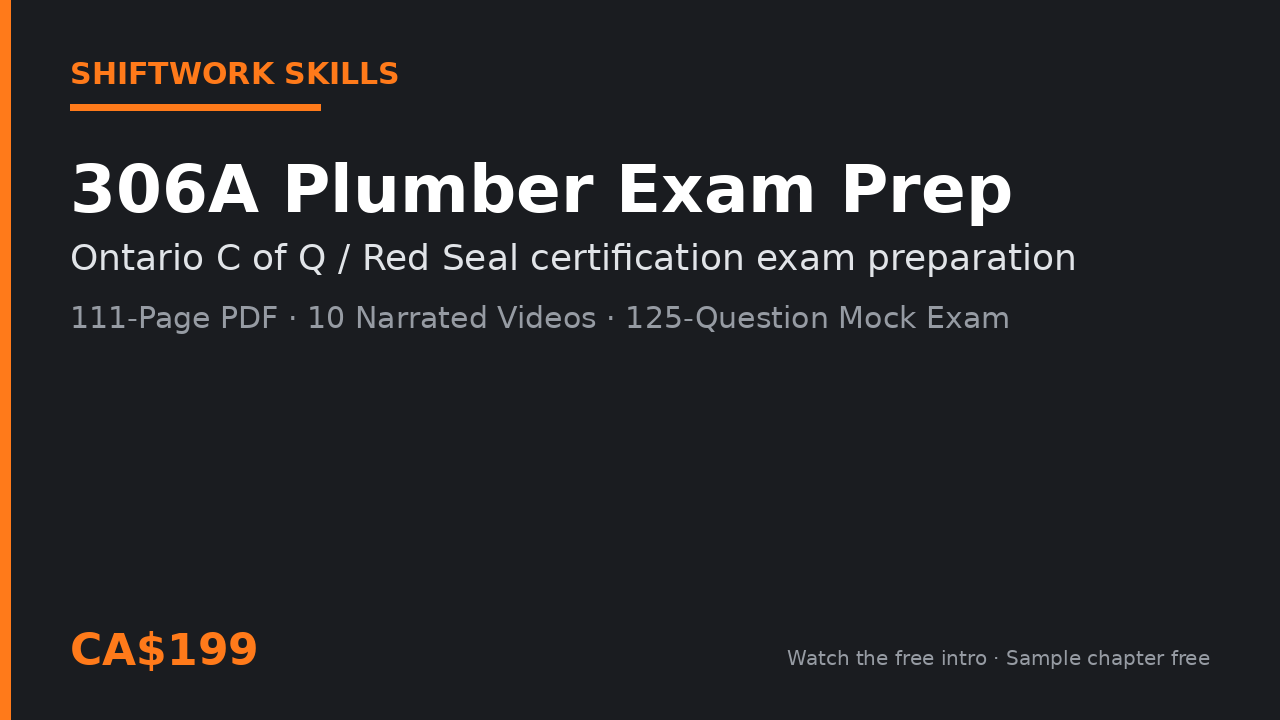
306A Plumber Exam Prep course cover — Ontario C of Q and Red Seal study guide
Video thumbnail — 306A Plumber Exam Prep course introduction Watch the course intro (2 min)

Exam Prep · Ontario / Red Seal

306A Plumber Exam Prep — Ontario C of Q & Red Seal Study Guide with Narrated Video Lessons and 125-Question Mock Exam

Prepare to pass your 306A exam with a complete 306A exam prep course for Ontario’s Plumber Certificate of Qualification (C of Q) and the Red Seal exam. 306A is a compulsory trade in Ontario — this exam is your licence to work. The real exam is 125 multiple-choice questions in 4 hours with a 70% pass mark, weighted the way this course is weighted — drainage, waste and vent work alone is 32 of the 125 questions — and a printed copy of the National Plumbing Code is supplied at the sitting, so the course drills fast, accurate code navigation as a tested skill in itself.

Who it’s for: 306A apprentices writing the C of Q for the first time, experienced plumbers challenging through the Trade Equivalency Assessment (TEA), and Red Seal candidates in every province — the interprovincial exam is the same exam across Canada.

What’s covered — the 10 modules

  1. How the Exam Works, and How to Study for It
  2. The Plumber Math and Code-Navigation Core
  3. Block A: Performs Common Occupational Skills (14 questions)
  4. Block B: Prepares and Assembles Tube, Tubing and Pipe (13 questions)
  5. Block C (Part 1): Sewers and Sewage Treatment Systems
  6. Block C (Part 2): Interior Drainage, Waste and Vent Systems
  7. Block D: Installs, Tests and Services Water Service and Distribution (24 questions)
  8. Block E: Installs, Tests and Services Fixtures, Appliances and Water Treatment Systems (17 questions)
  9. Blocks F and G: Hydronic and Steam Systems, and Specialized Systems (16 + 9 questions)
  10. Timed Mock Exam — a full 125-question mock in the real format, with answer key
  • 111-page PDF study guide
  • ~56 minutes of narrated video
  • 257 practice questions with explanations
  • Self-paced, yours to keep

Independent prep course built to the published 2023 Red Seal Occupational Standard blueprint — not affiliated with Skilled Trades Ontario, the Red Seal Program, or the CCDA, and every question is an original practice question written to the blueprint. Gas piping work in Ontario requires separate TSSA certification; this course covers the exam’s plumbing content, not a gas licence.

Try it first

Free Practice Questions

Ten questions taken straight from this course’s own practice sets — the same style, format and explanations you get inside. Check each answer as you go.

1. Which block is the largest on the 306A exam, and how many questions is it worth?

  • A. Block D, water service and distribution; 24 questions
  • B. Block C, sewers, sewage treatment and DWV systems; 32 questions
  • C. Block E, fixtures, appliances and water treatment; 17 questions
  • D. Block A, common occupational skills; 14 questions

Answer: B. Sewers, sewage treatment and DWV systems are 32 of 125 — one question in four — and interior DWV alone is about 63% of that block.

2. A drainage run must offset 450 mm using two 45° fittings. The travel piece (centre-to-centre, before fitting allowances) is:

  • A. 450 mm
  • B. 636 mm
  • C. 318 mm
  • D. 900 mm

Answer: B. Travel = offset × 1.414 = 450 × 1.414 = 636 mm. (318 mm is the result of dividing by 1.414 — the classic upside-down setup.)

3. A two-leg sling bridle lifts a boiler section. As the sling angle from horizontal decreases, the tension in each leg:

  • A. Decreases
  • B. Stays the same
  • C. Increases — flat slings multiply leg tension, which is why rigging is planned at steeper angles and always within the working load limit at the actual angle
  • D. Becomes zero at 30 degrees

Answer: C. Leg tension = load ÷ (number of legs × sin of the angle from horizontal). At 30° each leg of a two-leg bridle carries the full load's weight in tension.

4. Solder used on a potable water system must be:

  • A. 50/50 tin-lead
  • B. Lead-free, as the NPC's materials rules require for potable service
  • C. Acid-core
  • D. Any solder, provided flux is used

Answer: B. Lead-bearing solder is prohibited on potable water joints. (50/50 tin-lead is the classic distractor — it belongs to history and to non-potable applications of the past.)

5. In a septic tank, treatment occurs primarily by:

  • A. Chlorination
  • B. Separation and digestion: solids settle as sludge, floatables rise as scum, clarified effluent leaves from the middle layer, and anaerobic bacteria digest part of the solids during retention
  • C. Filtration through the tank walls
  • D. Aeration by the vent

Answer: B. The tank is a separator with digestion — which is why retention time (tank volume versus daily flow) is its sizing basis.

6. The minimum depth of a trap seal under the NPC is:

  • A. 25 mm
  • B. 38 mm
  • C. 50 mm
  • D. 75 mm

Answer: B. 38 mm of seal is the code's minimum barrier between the room and the sewer gas. (50 mm traps exist and are common, but 38 mm is the code minimum the exam asks for.)

7. A wet vent is:

  • A. A vent pipe that has become wet from a leak
  • B. A vent that also serves as a drainage pipe for another fixture — a pipe doing two jobs, sized for both duties under the code's wet-venting provisions
  • C. A vent below the flood level rim
  • D. A vent connected to a water line

Answer: B. Wet venting is a defined arrangement with its own sizing and fixture-order rules in Section 2.5 — the bathroom group is its home ground.

8. The most reliable form of backflow protection is:

  • A. A double check valve assembly
  • B. An air gap — a physical separation (at least 25 mm, and not less than twice the effective opening) with no moving parts to fail
  • C. A hose-bibb vacuum breaker
  • D. A single check valve

Answer: B. The air gap cannot stick, wear, or be bypassed. Mechanical devices are selected where an air gap is impractical — by hazard and mechanism, under Section 2.6 and the CSA B64 series.

9. An ion-exchange softener works by:

  • A. Filtering hardness particles out of the water
  • B. Exchanging hardness ions (calcium, magnesium) for sodium or potassium ions on a resin bed, regenerated periodically with brine
  • C. Boiling the water
  • D. Adding acid to dissolve scale

Answer: B. Exchange, not filtration — which is why a softener does not disinfect and does not remove sediment, and why its sizing is capacity (hardness × volume), not pore size.

10. A circulator makes a gravelly, rattling noise in operation. The likely causes, in diagnostic order, are:

  • A. Cavitation or air in the volute — check system pressure/fill and venting before condemning the pump
  • B. The boiler is too hot
  • C. The expansion tank is too large
  • D. The piping is oversized

Answer: A. Noise like gravel is vapour and air collapsing in the impeller's eye — a pressure-and-air problem first, a pump problem second.