
← All courses

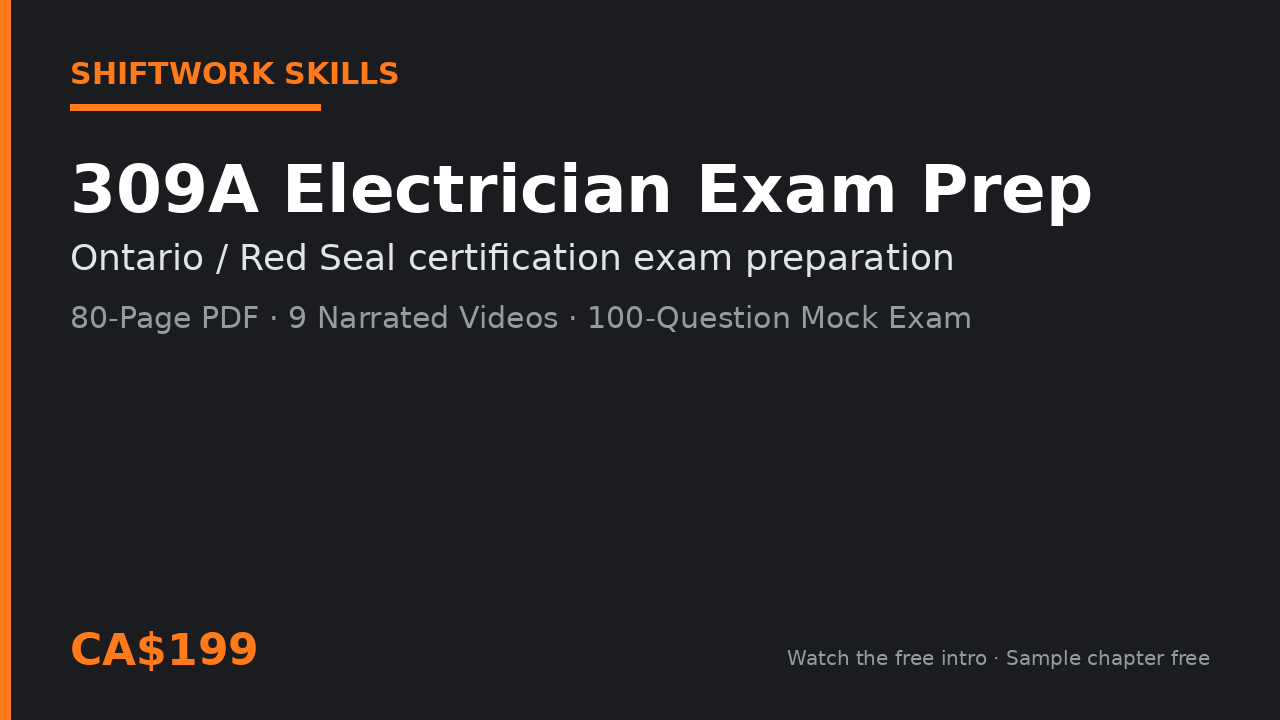
309A Electrician Exam Prep course cover — Ontario C of Q and Red Seal study guide
Video thumbnail — 309A Electrician Exam Prep course introduction Watch the course intro (1 min)

Exam Prep · Ontario / Red Seal

309A Electrician Exam Prep — Ontario C of Q & Red Seal Study Guide with Narrated Video Lessons and 100-Question Mock Exam

Prepare to pass your 309A exam with a complete 309A exam prep course for Ontario’s Construction and Maintenance Electrician Certificate of Qualification (C of Q) and Red Seal exam. The real exam is 100 multiple-choice questions in 4 hours with a 70% pass mark, and it is open-book — so it doesn’t test what you’ve memorized, it tests how fast you can find the right rule and how reliably you can do the calculations. This course trains exactly those two skills.

Who it’s for: 309A apprentices and journeyperson candidates in Ontario preparing to write the Certificate of Qualification / Red Seal exam, including anyone re-writing after a failed attempt.

What’s covered — the 9 modules

  1. How the Exam Works, and How to Study for an Open-Book, Code-Based Test
  2. Code Book Navigation: Finding Any Rule Fast
  3. The Calculation Core — loads, ampacity, voltage drop, conduit & box fill, motors, transformers
  4. Block A Review: Common Occupational Skills (11 questions)
  5. Block B Review: Generating, Distribution and Service Systems (28 questions)
  6. Block C Review: Wiring Systems (30 questions)
  7. Block D Review: Motors and Control Systems (21 questions)
  8. Block E Review: Signalling and Communication Systems (10 questions)
  9. Timed Mock Exam — a full 100-question mock in the real format, with answer key
  • 80-page PDF study guide
  • ~100 minutes of narrated video
  • 190 practice questions with explanations
  • 190 printable flashcards
  • Cheat sheets — quick reference
  • Printable study planner
  • 45 code-book lookup drills
  • Exam-day pack — top mistakes & pass checklist
  • Self-paced, yours to keep

Independent prep course — not affiliated with Skilled Trades Ontario, the Red Seal Program, or CSA. You’ll need your own current Canadian Electrical Code book, the same one you’ll use in the exam room.

Try it first

Free Practice Questions

Ten questions taken straight from this course’s own practice sets and module quizzes — the same style, format and explanations you get inside. Check each answer as you go.

Not sure where you stand? Take the free 309A Readiness Diagnostic

25 timed questions sampled across all five exam blocks — scored by block at the end, so you can see exactly which block is your weak spot. 60 minutes, open-book like the real exam, no email required.

Take the free diagnostic

1. How many questions are on the 309A Red Seal exam, and what is the pass mark?

  • A. 125 questions; 65%
  • B. 100 questions; 70%
  • C. 100 questions; 75%
  • D. 150 questions; 70%

Answer: B. 100 multiple-choice questions, 70% (70 correct) to pass, four hours to write.

2. Which table gives the minimum size of a bonding conductor for a service?

  • A. Table 13
  • B. Table 14
  • C. Table 16
  • D. Table 45

Answer: C. Table 16 sizes grounding and bonding conductors based on the size (ampacity) of the largest ungrounded conductor. You'll use it in Block B questions constantly.

3. A circuit supplies a continuous load of 64 A. What is the minimum rating of overcurrent protection (not a 100%-rated assembly)?

  • A. 64 A
  • B. 70 A
  • C. 80 A
  • D. 100 A

Answer: C. Continuous loads are limited to 80% of the circuit rating: 64 ÷ 0.80 = 80 A (equivalently, 64 × 1.25). Rule 8-104 method.

4. A 240 V single-phase run, 45 m one-way, carries 24 A on No. 8 AWG copper (resistance ≈ 2.06 Ω/km). The voltage drop is approximately:

  • A. 2.2 V (0.9%)
  • B. 4.4 V (1.9%)
  • C. 8.9 V (3.7%)
  • D. 17.8 V (7.4%)

Answer: B. VD = 2 × 45 × 24 × 2.06 ÷ 1000 = 4.45 V; 4.45 ÷ 240 = 1.85%. Within the 3% branch-circuit limit. Option C is the answer if you mistakenly double-count the length; option D if you also drop the ÷1000 discipline.

5. A 45 kVA three-phase transformer has a 600 V primary. Its rated primary current is approximately:

  • A. 25 A
  • B. 43.3 A
  • C. 75 A
  • D. 130 A

Answer: B. 45,000 ÷ (1.732 × 600) = 43.3 A. Option C is the single-phase answer (45,000 ÷ 600) — the √3 trap again.

6. What is the final step in a proper lockout/tagout procedure before work begins?

  • A. Apply tags
  • B. Notify the supervisor
  • C. Verify zero energy (absence of voltage), testing the tester before and after
  • D. Release stored energy

Answer: C. Releasing stored energy comes before verification; verification — with a live-dead-live tester check — is the last step before hands touch conductors.

7. What actually causes an overcurrent device to trip quickly on a ground fault in a metal enclosure?

  • A. Current flowing through the earth back to the source
  • B. The low-impedance bonding path returning fault current to the source, driving the device to trip
  • C. The grounding electrode dissipating the fault
  • D. The GFCI in the main panel

Answer: B. Bonding — not earthing — clears faults. The earth is far too high an impedance to trip a breaker; the bonded metal path back to the source neutral is what produces tripping current.

8. A receptacle is installed 1.2 m from the edge of a bathroom sink. What protection is required?

  • A. AFCI protection
  • B. Class A GFCI protection
  • C. Tamper-resistant only
  • D. No special protection

Answer: B. Receptacles within 1.5 m of a sink, tub, or shower require Class A GFCI protection (Section 26). Bathroom receptacles are, notably, among the exceptions to the dwelling AFCI requirement — the two protections are not interchangeable.

9. A motor is controlled by a three-wire start/stop station. Power fails for ten seconds, then returns. What happens?

  • A. The motor restarts immediately
  • B. The motor restarts only if the overloads are reset
  • C. The motor stays off until the Start button is pressed again
  • D. The contactor seals in through the stop button

Answer: C. Three-wire control provides low-voltage protection: the seal-in drops out with the coil, and a deliberate restart is required. Automatic restart after an outage is the behaviour of two-wire control (low-voltage release).

10. After a new fire alarm system is installed, it must be verified in accordance with which standard?

  • A. CAN/ULC-S524
  • B. CAN/ULC-S537
  • C. CAN/ULC-S561
  • D. CSA C22.1, Section 32

Answer: B. S537 is the verification standard — the system is tested device-by-device and documented after installation. S524 governs the installation itself; S561 covers signal monitoring; Section 32 is the Code's installation rules.

Included with the course

Flashcard Sampler

Twelve cards from this course’s 190-card flashcard deck. The full deck — every practice and mock question in the course, as a printable PDF — is included with the course. Check each answer as you go.

1. How many questions are on the 309A Red Seal exam, and what is the pass mark?

100 questions; 70% — 100 multiple-choice questions, 70% (70 correct) to pass, four hours to write.

2. Which table gives the minimum size of a bonding conductor for a service?

Table 16 — Table 16 sizes grounding and bonding conductors based on the size (ampacity) of the largest ungrounded conductor. You’ll use it in Block B questions constantly.

3. Which section of the Code covers grounding and bonding?

Section 10 — Section 10 — Grounding and bonding. Table 16 (sizing) is used with it constantly; expect several exam questions to route through this section.

4. A circuit supplies a continuous load of 64 A. What is the minimum rating of overcurrent protection (not a 100%-rated assembly)?

80 A — Continuous loads are limited to 80% of the circuit rating: 64 ÷ 0.80 = 80 A (equivalently, 64 × 1.25). Rule 8-104 method.

5. A 45 kVA three-phase transformer has a 600 V primary. Its rated primary current is approximately:

43.3 A — 45,000 ÷ (1.732 × 600) = 43.3 A. Option C is the single-phase answer (45,000 ÷ 600) — the √3 trap again.

6. A Class A GFCI trips when the ground fault current reaches approximately:

5 mA — Class A GFCIs trip in the 4–6 mA band (nominally 5 mA) — low enough to protect a person. Equipment ground fault protection operates at far higher levels for a different purpose.

7. Where the connected load is not known, the maximum number of outlets permitted on a two-wire 15 A branch circuit is:

12 — Twelve outlets maximum (Rule 8-304) when loads aren’t known; known loads are calculated instead of counted.

8. To reverse the rotation of a three-phase induction motor, you should:

Interchange any two of the three supply leads — Swapping any two phases reverses the phase sequence and therefore the rotating field. Reversing all three changes nothing (the sequence is preserved).

9. In structured cabling, the maximum length of a horizontal cable run is:

90 m (with the total channel, including patch cords, at 100 m) — Ninety metres of horizontal cable plus up to ten metres of patch cords equals the 100 m channel. Option C double-counts the allowance — the classic trap.

10. In the Canadian Electrical Code, “high voltage” means voltage exceeding:

750 V — High voltage in the Code means exceeding 750 V.

11. The minimum cover for a direct-buried cable in an area not subject to vehicular traffic is generally:

600 mm — Direct-buried cable, non-vehicular area: 600 mm minimum cover (900 mm under vehicles).

12. A four-pole induction motor has a nameplate speed of 1725 rpm on 60 Hz. Its full-load slip is approximately:

4.2% — Slip = (1800 − 1725) ÷ 1800 = 4.2%.