
← All courses

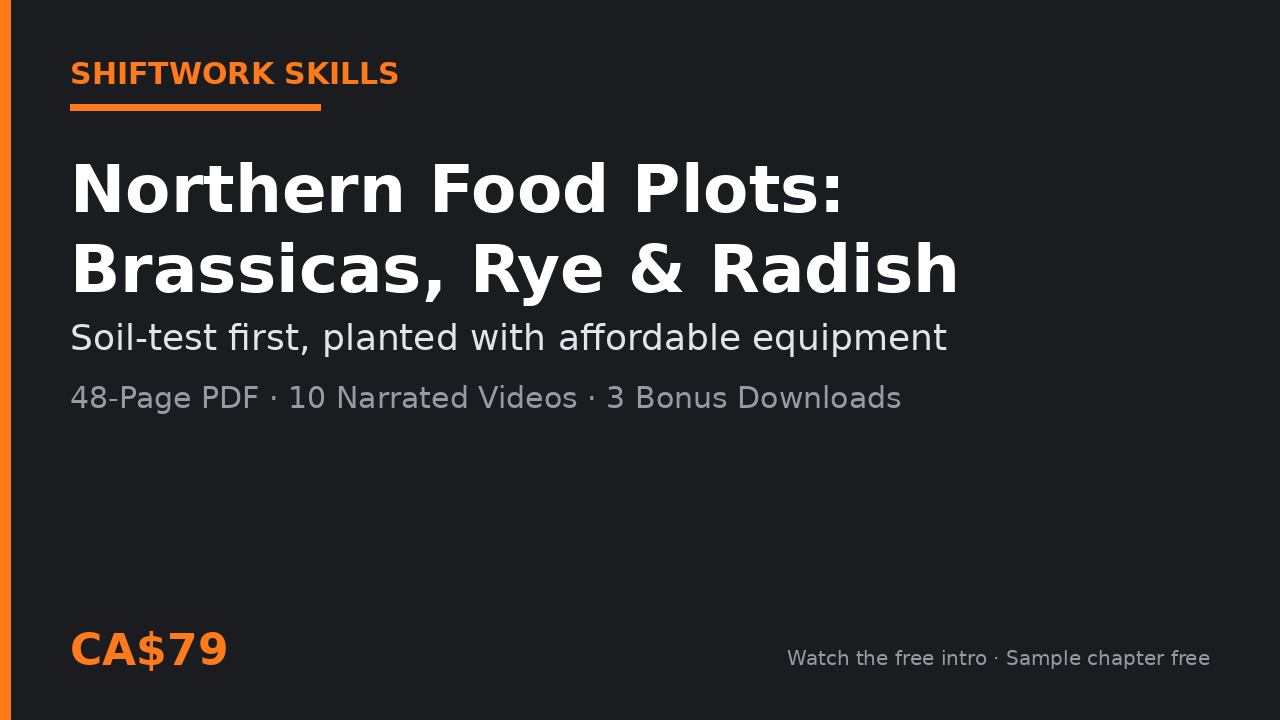
Northern Food Plots course cover — brassicas, rye and radish, soil-test first, planted with affordable equipment
Video thumbnail — Northern Food Plots course introduction Watch the course intro (2 min)

Hands-On · Northern Food Plots

Northern Food Plots: Brassicas, Rye & Radish — Soil-Test First, Planted with Affordable Equipment

Most food plot advice is written for farm country with deep soil and a tractor. This course is built for northern ground — thin, rocky, acidic Canadian Shield soil — and it starts where successful plots actually start: with a soil test. Read the report line by line, fix pH and fertility by the numbers, then plant brassicas, forage radish, cereal rye and soybeans in a three-year rotation using the equipment northern hunters actually own: an ATV and an old grain drill.

Who it’s for: Hunters and landowners planting small northern plots who are tired of seed that disappoints. Every rate is given two ways — the published book rate, and the heavier rate actually planted on hard-browsed northern ground, with the reasoning stated — and the equipment module walks through buying and calibrating a used John Deere Van Brunt-style grain drill instead of a five-figure no-till drill.

What’s covered — the 10 modules

  1. Start With the End in Mind
  2. Soil Testing Done Right
  3. Fixing the Soil
  4. Site Prep
  5. Equipment on a Budget
  6. Seed Selection
  7. Planting Brassicas & Radish
  8. Planting Cereal Rye & Fall Grains
  9. Feeding & Troubleshooting the Plot
  10. The Year-Round Plot Calendar
  • 48-page PDF course book
  • ~57 minutes of narrated video
  • 3 bonus downloads — soil test worksheet, seeding-rate cheat sheet, annotated sample report
  • Self-paced, yours to keep

Herbicide content is principles-only — the product label and Ontario rules govern. Seeding rates are extension-published recommendations alongside the author’s heavier high-browse practice, labelled as such wherever they appear.

Try it first

Free Practice Questions

Ten questions taken straight from this course’s own practice sets and module quizzes — the same style, format and explanations you get inside. Check each answer as you go.

1. When and how should you take a soil sample for a new northern food plot?

  • A. In spring — walk a zigzag across the plot taking 10 to 15 cores, 0 to 6 inches deep, and mix them in a clean plastic bucket
  • B. The week before planting — one deep core from the middle of the plot is enough
  • C. In fall, after the season — surface scrapings from the plot’s best corner
  • D. Any time of year — a single sample from beside the gate

Answer: A. Sample in spring for a late-summer planting, so lime has time to work. The sample has to represent the whole plot: 10 to 15 cores on a zigzag or W pattern, 0 to 6 inches deep, mixed in a clean plastic bucket — and send it to an OMAFRA-accredited lab.

2. Your soil report comes back at pH 5.3 with magnesium rated low. Which lime do you buy?

  • A. Calcitic lime — it raises pH the fastest
  • B. Dolomitic lime — it raises pH and supplies the magnesium the soil is short of
  • C. Skip the lime and add extra nitrogen fertilizer instead — it does the same job
  • D. Either type — magnesium has nothing to do with the choice

Answer: B. The magnesium line on the report makes the lime decision: low magnesium means dolomitic lime, which raises pH and supplies magnesium at the same time. If magnesium were adequate or high, calcitic lime would be the choice.

3. What soil pH do brassicas perform best at, and when should lime be applied?

  • A. pH 5.0 to 5.5 — spread the week you plant
  • B. pH 7.0 to 7.5 — spread right after planting
  • C. pH 6.0 to 6.5 — spread in spring, at least 6 to 12 weeks before planting
  • D. pH doesn’t matter if you fertilize to the report — lime can go on any time

Answer: C. Brassicas perform best at pH 6.0 to 6.5, and below that they can’t use fertilizer properly no matter how much you apply. Lime reacts over months, not days, so it goes on 6 to 12 or more weeks ahead of planting — spring application for a late-summer planting is better still.

4. On a northern plot that deer browse hard, how does this course adjust the fertilizer rates from the soil test report?

  • A. Double them — a browsed plot needs all the feed it can get
  • B. Fertilize exactly to the report — browsing doesn’t change the math
  • C. Add about 10 percent to the lime rate as well, to be safe
  • D. Add about 10 percent across the whole fertilizer program — nitrogen, phosphorus and potassium — and leave lime exactly at the report rate

Answer: D. On high-browse northern ground, browsed plants need extra feed to regrow after each biting, so the course adds about 10 percent on top of the soil-test rates across the whole fertilizer program. Lime is the exception and is never adjusted — it’s dosed to a pH target, and extra lime overshoots it.

5. You’re broadcasting a brassica blend on a plot that gets browsed hard. The book rate is 4–6 lb per acre broadcast. What does this course plant?

  • A. 2–3 lb per acre — with seed that small, less is safer
  • B. The book rate plus a measured 1–2 lb per acre — about 5–8 lb per acre total for the blend, weighed for your plot size
  • C. Each species in the blend at its full pure-stand rate, added together
  • D. 10–12 lb per acre — the same rate as forage radish

Answer: B. The extra 1 to 2 lb per acre pre-plants the plants the deer are going to remove, so the stand that’s left still closes canopy. Two disciplines hold: in a blend, the total goes down at the blend rate (never pure-stand rates added together), and the seed is weighed for the measured plot size, never guessed.

6. On browsed northern ground, at about what rate does this course plant cereal rye?

  • A. About 25 lb per acre
  • B. About 50–60 lb per acre — the published cover-crop minimum is plenty for a food plot
  • C. About 100 lb per acre
  • D. About 175 lb per acre

Answer: C. Published cover-crop guidance starts around 50 to 60 lb per acre drilled, but a food plot is a feed crop that gets eaten from the day it emerges. About 100 lb per acre — roughly double the starting book rate — is browse allowance, and the dense stand doubles as a weed blanket.

7. What is forage radish’s main job in the plot, and what happens to it over a northern winter?

  • A. It feeds deer all winter and comes back on its own in spring
  • B. It fixes nitrogen like a legume, so the next crop needs less fertilizer
  • C. It’s grown for its bulb, which deer dig through the snow in late winter
  • D. Its long taproot loosens compacted ground and scavenges leftover nitrogen — and it winter-kills reliably, so it never becomes next year’s weed

Answer: D. Radish is the soil engineer of the brassica family: the long taproot drills into compacted ground, scavenges leftover nitrogen, and rots away over winter leaving looser soil behind. It winter-kills reliably in the north, which is a feature — it never becomes next year’s weed. (The bulb deer dig through snow is the turnip’s job.)

8. What is the three-year rotation this course runs on each plot?

  • A. Brassicas → soybeans → cereal rye
  • B. Brassicas → brassicas → soybeans
  • C. Soybeans → cereal rye → soybeans
  • D. Brassicas every year, with extra fertilizer to make up for it

Answer: A. Brassicas in year one, soybeans in year two, cereal rye in year three, then back to brassicas. The bean year adds nitrogen instead of drawing it, the rye year rebuilds organic matter and smothers weeds, and brassicas never sit on the same ground long enough for diseases like clubroot to build up — the hard rule is never more than two successive years, and this rhythm gives them one year in three.

9. When do you plant brassicas in most of Ontario, and how deep?

  • A. Late August into September, 1 to 2 inches deep so the seed finds moisture
  • B. Right after spring soil testing, about half an inch deep
  • C. 60 to 90 days before the average first killing frost — mid-July to early August in most of Ontario — no deeper than 1/4 inch, on a firm seedbed
  • D. Any time in summer — broadcast it on the surface and leave it unpacked

Answer: C. Brassica timing counts backwards from frost: 60 to 90 days before your area’s average first killing frost, which is mid-July to early August in most of Ontario. The seed is tiny with small reserves, so it goes no deeper than 1/4 inch on a firm seedbed — and the plot gets packed after planting for seed-to-soil contact.

10. Your new plot tests at pH 5.3 and you’ve spread lime this spring. What do you plant this fall?

  • A. Brassicas — the lime will have the pH fixed by planting time
  • B. Cereal rye — it produces at pH down to about 5.0 to 5.5 while the lime works; re-test next spring and plant brassicas once the pH is up near 6.0
  • C. Clover — it’s the crop that tolerates acid soil best
  • D. Nothing — rest the ground for a full year while the lime works

Answer: B. This is the soil-test-first system working as designed: at pH 5.3 the ground is too acid for brassicas this year, but cereal rye produces down to about pH 5.0 to 5.5, so it feeds deer this fall while the lime does its slow work. Re-test next spring; when the pH has moved up near 6.0, the brassicas go in.